Supports portable, low-cost, on-site ion sensing in environmental, agricultural, hydroponic, aquaculture, and point-of-care settings
Background
Calibration-free solid-state ion-selective electrodes (ISEs) suggest overlapping calibration curves owing to the fixed interfacial potential between the electrode/solid state back contact/ion-selective membrane (ISM) layers. To be deemed calibration free, an ISE is required to have a known stable intercept together with a reproducible Nernstian or near-Nernstian response. Further, after their initial calibration, these ISEs should not have to be calibrated in fresh solution owing to drift in the intercept of the linear calibration curve. A poorly defined and drifting interfacial potential of the ISE can arise, among other reasons, from the formation of interfacial (electrode/solid-state back contact/ISM) water layers, irreproducible device-to-device potentials, and mechanical and chemical instability of back contact material, which are long-standing challenges in designing a calibration-free solid-state ISE. This is further complicated by the use of different electrode materials, different back contact material layers, and different ISMs to design effective ISEs that offer a low limit of detection (LOD), high sensitivity, and a large dynamic range, with high selectivity and reproducible measurements for their intended use. This technology addresses these challenges to provide calibration‑free operation in a screen‑printable ISE.
Technology Description
This technology is a reusable, calibration-free screen-printed ion-selective electrode platform for measuring ions such as sodium and calcium in aqueous samples. The electrode assembly uses a screen-printed carbon electrode, a conductive carbon back-contact layer, a PEDOT:PEDOT-S conducting polymer layer, and an ion-selective membrane containing the relevant ionophore. A low-current electrochemical pre-treatment process further sets and stabilizes the back-contact potential, enabling electrodes from the same or different batches to use a shared working equation without recalibration before each measurement. The technology is designed to support portable, low-cost, on-site ion sensing in environmental, agricultural, hydroponic, aquaculture, and point-of-care settings.
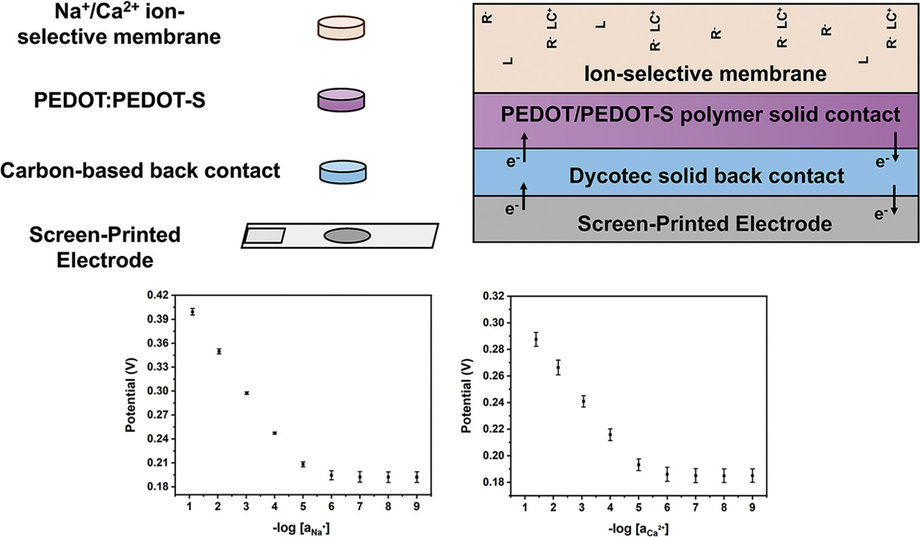
Fig. 1
Further Details
More detailed information can be found in this publication: https://doi.org/10.1016/j.snr.2025.100367
Benefits
- Calibration-free operation for at least seven days after initial setup
- Reusable screen-printed ion-selective electrode format reduces cost per measurement
- Rapid response times
- Stability across electrode batches and after dry storage
- Compatible with inexpensive carbon screen-printed electrodes
Applications
- Water quality monitoring
- Hydroponic nutrient monitoring
- Aquaculture and agricultural water testing
- Soil and plant nutrient diagnostics
Status
Seeking development partner, commercial partner, licensing. US Provisional Patent Application No. 63/873,164